
|
|
|
|
#1
 06-09-2010, 09:10 PM
|
|||
|
|||

Oh, believe me, I don't have every one - I still have about 100 pistols on my wish list (some of which are admittedly 19th century).
I got the P.38 from another collector, I think I paid about $500 for it. Other than the recent glut of Russian imports P.38s are probably the most common WW2 pistol to find. And honestly, although my collection definately needed one, I'm not a big P.38 fan. Great technical acheivement, but it's one of the bulkiest pistols I own (espescially for a 9mm) and doesn't handle well. 
|
|
#2
06-09-2010, 10:02 PM
|
||||
|
||||
|
Quote:
|
|
#3
06-09-2010, 10:26 PM
|
||||
|
||||
|
Awesome collection. The Luger artillery model with the snail drum mag on top, I've heard they're pretty rare. Is that true?
__________________
"Everything is impossible until somebody does it - Batman RIP Kevin Conroy, the one true Batman
|
|
#4
06-09-2010, 10:56 PM
|
|||
|
|||
|
The Artillery Luger is pretty rare, yeah. In that States that gun would probably sell for $2400 - $2800 in that condition (all matching, minor pitting, missing the original mag). The drum is extremely rare, I've seen them sell for $1800 in the same condiion. The loading tool (not pictured) for the drum is even rarer - I had to buy one from Europe. I'm also going to pick up an original stock, which will probably cost me $750.
|
|
#5
06-16-2010, 05:54 PM
|
|||
|
|||
 This was actually the first gun I bought since I came home - a Mexican Mauser M1904 carbine in 7mm Mauser, made by DWM. It's a true cavalry carbine, with no bayonet lug and side mounted swivels, and quite short. Mexican Mausers are very hard to find, but espescially ones that date to the revolution - 10 years of heavy fighting in the hands of irregular troops is not exactly the recipe for a high survival rate. It's been rearsenalled several times, and the Mexican crest and receiver markings can only be seen under good light, but it's in great shootable condition. Interestingly, this was sold to me as a Mexican-made M1910 carbine, but when I got it you can see it's a German-made contract gun. Which is both rarer and far more interesting, as production of the M1910 didn't really get up to speed until the 20s, after the revolution was essentially over.
|
|
#6
06-16-2010, 06:55 PM
|
||||
|
||||
|
Quote:
|
|
#7
06-30-2010, 07:48 PM
|
|||
|
|||
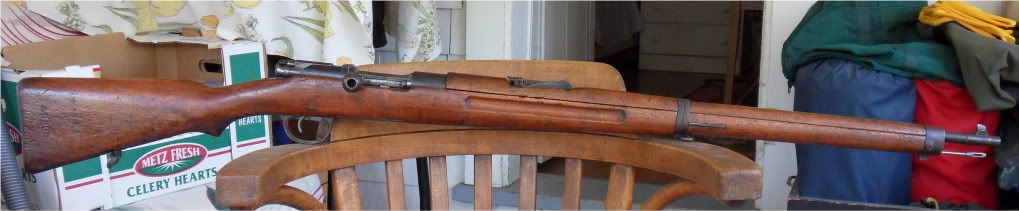 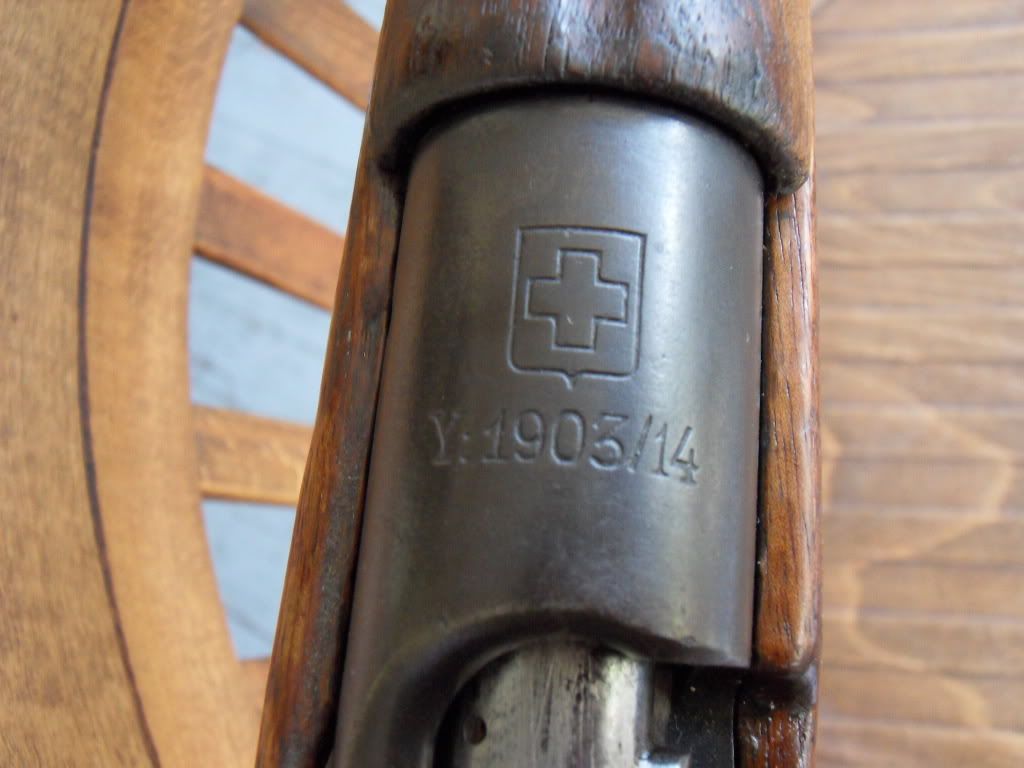 Greek crest on the receiver. 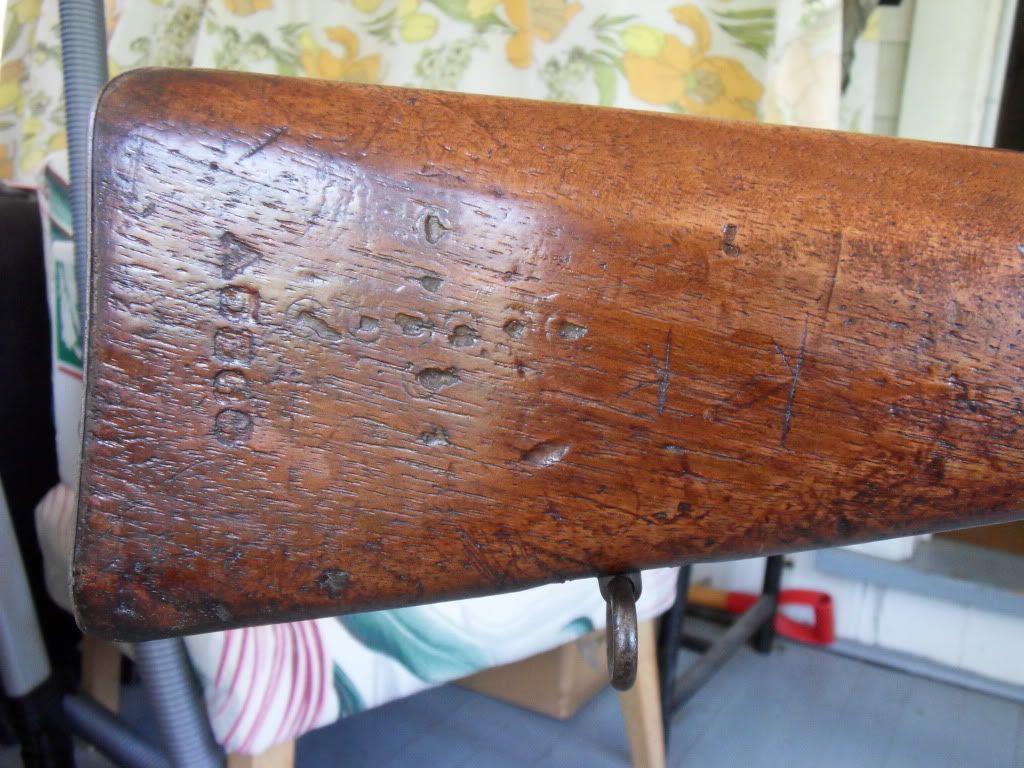 Greek cross trench art on the butt. Another one I've bought since coming home - this was too good a deal to pass up. It's a Greek Mannlicher-Schönauer Y:1903/14 rifle, made by Breda in 1927. It shoots a 6.5 x 54mm round from a unique rotary magazine. Combined with the improved Mannlicher turnbolt (it has a reinforcing rib to prevent bolt wobble) it's supposed to be really smooth to operate - though I don't find it any better than a Mauser 98 and not as good as a Lee-Enfield. It's hard to find militay Mannlicher-Schönauers in any condition for a few reasons - up until the end of WW2 they were really well-regarded high-end sporting rifles, so the military ones tended to get sporterised more than other models. The Greeks were actually the only military ever to issue them in any number, as the rotary magazine was expensive and didn't offer any real advantages. They were used in 6 wars in 40 years, all of which went badly for the Greeks, so they're hard to find today. The other interesting thing about them is the Greeks always had trouble getting them in wartime - mostly because they ended up going to war with the country supplying them. They fought on the allied side in WW1, cutting themselves off from Steyr in Austria who was originally the ones making them. After WW1, when Austrian arms production was limited by the treaty of Versailles, they contracted from Breda in Italy - who of course ended up invading Greece in 1940. By that time they'd also ended began supplementing them with Mauser Model 1930s from FN - which of course was cut off when Germany invaded Belgium. If ever there was an argument for domestic arms production, there it is. Last edited by Nyles; 06-30-2010 at 07:50 PM.
|
 |
|
|


 Hybrid Mode
